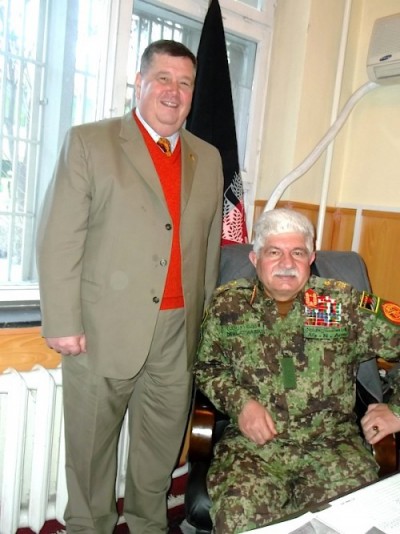
University of Mississippi Director of Public Relations Danny Blanton, left, with Gen. Sher Mohammad Karimi, chief of army staff of the Military of Afghanistan.
In August 1982, a wide-eyed boy from the Mississippi Delta enrolled in the University of Mississippi. Thirty years later, with a little more wisdom and several grey strands, that same boy returned as the university’s Director of Public Relations.
I returned to my alma mater in August 2012 from a job I was very committed to in an austere area vastly misunderstood – Kabul, Afghanistan. As I was being reintroduced to an Ole Miss campus that barely resembled the one I walked across as a student, people would often ask me where I came from and invariably respond, “You came from hell to heaven.”
While I agree that this is about as close to heaven as it gets, I did not see Kabul as the opposite. People’s perception of areas they haven’t experienced is derived from what they see and read, which is often misleading. Sure, there are dangerous areas of Kabul, but there are areas of large American cities that are just as dangerous and require an equal amount of caution.
My job was civilian advisor to the Afghan Minister of Defense so I spent the majority of my days in the Ministry of Defense. I worked with fascinating men like Minister of Defense Rahim Wardak and Gen. Sher Mohammad Karimi, Chief of Army Staff of the Military of Afghanistan. They were intelligent, well educated men with unparalleled courage and patriotism. When these men were my age, they were running the Soviet Union out of Afghanistan. I can’t run my neighbor’s cat out of my yard. They also spoke English as well as, if not better, than I.
Over the years I was there, we worked together through many crisis situations like the Quran burning at the Parwan Detention Facility when they ushered us into an underground room due to rioting in the streets. We also worked together to respond to the murder of 17 Afghans (including women and children) killed by an American soldier. My job was to help them avoid losing the support of their populous. Working through issues like these only strengthens the bond among men, and I rewarded their trust in me with my loyalty.
Through it all I never felt that I was directly threatened. I typically made the 30-minute walk from my safe house to my office each morning alone. My interpreter accompanied me on the walk from my office to the MOD and back. I would leave the office at approximately 8 p.m. and return to my safe house and do it all over again the next day. I made these walks by choice, mostly because I needed the exercise. I didn’t wear body armor or a helmet. I wore a suit each day much like I do now. Granted, I had a loaded 9mm pistol in a shoulder holster under my jacket, but I was still wearing a suit.
I said all that to say this – I did not come to Ole Miss to leave Afghanistan. I left Afghanistan because I had an opportunity to return to my alma mater, a place that played such a huge role in making me who I am. If any other company came calling, I would not have entertained the thought of leaving Afghanistan because I was committed to the work being done there. But I couldn’t resist the opportunity to return to Ole Miss and be a part of a university that for 30 years has been such a big part of me.
It’s hard to articulate what it really means to be an alumnus of Ole Miss to those who haven’t had the experience of being molded by this university during their formative years. The words Frank E. Everett, Jr. wrote are true, “The university gives a diploma and regretfully terminates tenure, but one never graduates from Ole Miss.” I have carried Ole Miss in my heart throughout my adult life and never actually left, so how could I resist the opportunity to protect the status of something I love so much? This is not my job. This is my university. I honestly approach every day with that attitude.
I still miss Afghanistan and the men I worked with and came to know. I miss the opportunity to help a fledgling government establish a democracy, an effort with long-lasting international impact. So if that was hell I was willing to endure it. As for heaven, if it’s anything like Ole Miss then it’s worth the effort to get there.