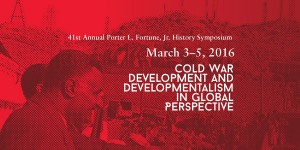
Porter Fortune Symposium scheduled March 3-5.
OXFORD, Miss. – The causes and trajectory of the Cold War have frequently been explored by historians, but only recently from a global perspective.
The place of economic development and developmentalism as part of the global Cold War takes center stage next week at the University of Mississippi during the 41st Annual Porter L. Fortune Jr. History Symposium.
The event, entitled “Cold War Development and Developmentalism in Global Perspective,” begins Thursday (March 3) with a keynote address by Robert Karl of Princeton University. The address is slated for 8 p.m. in the Joseph C. Bancroft Conference Room at the Croft Institute for International Studies.
The symposium continues with a series of panel discussions Friday (March 4) in the Ole Miss Student Union, Room 404. All symposium events are free and open to the public.
“In the last decade, there has been a wave of scholarship as part of the so-called ‘new international history’ that has incorporated the perspective of ‘developing’ countries in writing the history of the Cold War,” said Oliver Dinius, Croft associate professor of history and co-organizer of the symposium.
“Both the United States and the Soviet Union used economic development to exert their influence and to advance their geostrategic ends. Against that backdrop, the symposium highlights the perspective of the parts of the world that were subjected to these development initiatives.”
For his keynote address, Karl plans to examine “From the History of Developmentalism to the History of Inequality: Elites, Democracy and Cold War in Colombia.”
His lecture focuses on how a group of Colombian businessmen, known colloquially as “la Mano Negra,” or “the Black Hand,” shaped the implementation of development during the late 1950s and early 1960s. In a country heralded as a hemispheric model of reform, elite involvement in community development was a means to mobilize the forces of counterrevolution.
“By placing specific elites into the politics of developmentalism, the talk creates a link between the history of developmentalism and the history of inequality,” said Joshua Howard, UM associate professor of history and the symposium’s other co-organizer.
The symposium resumes at 8:30 a.m. Friday with a series of panels on specific case studies of development in the Cold War.
The morning sessions feature Benjamin Zachariah, of Universität Trier in Germany, speaking on “The Developmental Imagination and India: Cold War Remodelings”; Eva Maria Muschik, of New York University, discussing “The United Nations Approach to Development ii The UN, Decolonization and the Proposal for an International Administrative Service”; Eve E. Buckley, of the University of Delaware, examining “Hunger Politics in the Early Cold War: Brazilian Critiques of Overpopulation Discourse 1945-1960”; and Huaiyin Li, of the University of Texas, looking at “Geopolitical Setting and Development Strategy in Maoist China.”
The afternoon sessions include presentations by Nancy Reynolds, of Washington University, on “Egypt’s ‘Bright Beacon to Africa’: The Affective Decolonization and Regional Development in the 1960s”; Alessandro Iandolo, of the London (UK) School of Economics, on “Politics by Other Means: Soviet Trade with Ghana and Mali as Cold War Development Competition”; Covell Meyskens of the Naval Postgraduate School, on “Life Deferred in Mao’s Town: The Cold War, Late Development and China’s Third Front”; and (in absentia) Miguel Bandeira Jerónimo, of Center for Social Studies at the University of Coimbra in Portugal, on “Repressive Developmentalisms: Late Colonialism, Development Policies and Trajectories of Imperial Disengagement in Africa (1945-1975).” Dinius will present Jerónimo’s paper in his absence.
The symposium concludes Saturday (March 5) with an 8:30 a.m. roundtable featuring all symposium presenters in the Gerald M. Abdalla Board Room of the Croft Institute.
For people with an interest in world affairs since 1945, the symposium offers new perspectives on the current place of the United States in the world and the attitudes toward the United States in developing countries, Howard said.
“The foreign policy approaches of the Cold War shaped today’s interaction of the United States with the world in profound ways, and U.S. foreign policy today is often interpreted in that context from the perspective of the developing countries,” he said.
“Students in my classes on the Cold War often comment that studying that period helps them understand recent U.S. policy, not least the military interventions and their aftermath in the Middle East and Central Asia,” Dinius said. “The ideologies of modernization and development continue to inform foreign policy today, and we can see traces of Cold War approaches in the attempts to manage Afghanistan and Iraq, in particular.”
The Porter L. Fortune Jr. History Symposium began as an annual conference on Southern history in 1975. In 1983, it was named for the university’s 13th chancellor to honor his contributions to its success. Previous events have examined topics such as religion in the South, medicine and technology in the Civil War, women’s history, and the place of the American South in the world.
For more information, visit http://www.olemiss.edu/depts/history or call the Arch Dalrymple III Department of History at 662-915-7148. For assistance related to a disability, call 662-915-7148.