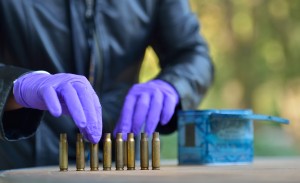
Shannon Roy lines up the shell cases to determine which ones have easily identifiable fingerprints. Photo by Robert Jordan/Ole Miss Communications
OXFORD, Miss. – On a recent crisp fall morning at Rowan Oak, the present mingled with the past as police officers and University of Mississippi researchers gathered to search for “evidence.”
The focus of this search, which did not require a warrant, was a box of old shell casings that belonged to the home’s former owner, William Faulkner.
The goal was to obtain Faulkner’s fingerprints, said Gregory Heyworth, associate professor of English and director of the Lazarus Project.
“The value of the fingerprint for the collection is to establish it as Faulkner’s print,” Heyworth said. “We know that it’s a Faulkner poem, but if we can establish the Faulkner print, then we can also use this technique on other historical objects, and that’s very important. For the Faulkner collection itself, I think it’s important to track other objects, and what better way then with fingerprints? It is an historical bit of information that is extremely intimate.”
Bill Griffith, curator of Rowan Oak, said that he tried to find something that would still hold a fingerprint after 50 years, and decided on an old tin tobacco box, which held almost a dozen shell casings from Faulkner’s Remington .308 Winchester.
For Griffith, it was remarkable to watch the process.
“I had no idea how involved it would be, and that they actually got fingerprints off of these shell casings,” Griffith said. “When they first came out here some time ago, that’s the only thing I could think that might have fingerprints on it that hadn’t been disturbed since he lived here. I was dubious about it, I didn’t think they would be able to find anything, but they did and I’m really excited.”
A real, physical connection between the author and his writing would also be useful for identifying other objects in the Faulkner collection, Heyworth said.
The story of the fingerprints began in the very cold winter of 1942, when a fire broke out in the hearth of Phil Stone’s house. Stone was a friend and early mentor to Faulkner.
“Phil Stone’s wife had the family handyman, Preacher Liggin, look for her husband’s papers, which were stored in a closet on the second floor,” Heyworth said. “He pulled out several boxes of, among other things, Faulkner’s apprentice poetry. Many things were lost but the collection he looked at, ultimately, was taken from the cinders there, and forms The Wynn-William Faulkner Collection, held at the University of Mississippi.”
About a year-and-a-half ago, Heyworth took a group of Honors College students to image the collection and while they were imaging, discovered a fingerprint. Although fingerprints cannot be lifted from historical documents by traditional means without the risk of damage, multispectral imaging – in which high-resolution digital photographs are taken, using 12 wavelengths of light between the ultraviolet and the infrared – has proven to be an effective new way of capturing evidence.
“Normal photography is quite limited in its range, and in its contrasts, the prints are nearly invisible,” Heyworth said. “With multispectral imaging, we stack the images and render them in software to create the highest contrast to see things that aren’t at all visible in normal light.”
With that technology, a clearer image of what appears to be a left-hand thumbprint was discovered.
Since there is a problem of textual recovery and identification of manuscripts, the Lazarus Project was founded to address these larger problems with the damaged historical documents.
The mission of the Lazarus Project is threefold: to facilitate manuscript recovery by providing researchers with access to multispectral technology, to train students and textual scholars in the use of multispectral technology and image rendering and in the scientific disciplines of the new codicology, and to collect data and metadata on damaged manuscripts as a basis for subsequent scholarship.
Since its inception, the Lazarus Project has used its portable multispectral lab to analyze several documents, including the Skipwith Revolutionary War Letters, which were donated to Ole Miss by Kate Skipwith and Mary Skipwith Buie, great-granddaughters of Gen. Nathanael Greene; and the Wynn Faulkner Poetry Collection, 48 pages of early poetry written by William Faulkner between 1917 and 1925 that were donated by Leila Clark Wynn and Douglas C. Wynn.
Heyworth and his students traveled to Germany to recover a 14th century Old French manuscript heavily damaged in World War II and have gone to Washington, D.C., to examine a possible William Shakespeare signature.
Shannon Roy, who works at the Mississippi Crime Lab in Batesville, came to Rowan Oak to help with the project in her spare time. She was able to lift two usable prints from the shells. Like a scene from “CSI,” Roy put the shell casings in an acrylic box and piped in super glue fumes to work her magic.
“There were two etched prints that were left and embedded into the two shell casings,” Roy said. “The pattern type that we actually saw was a right-sloped loop and a looping-type tinted arch, so it could be an arch or it could be a raised slope loop. The detail was also developed with super glue (and) black fingerprint powder and was lifted and photographed, but all photographs were taken prior to lifting and prior to super glue fuming, and we have two usable fingerprint patterns that actually came off of two of the shell casings.”
Next, Heyworth said, the team will develop the images and try to compare the two prints.
“We’re hoping that we have a left-hand print in there, but if we don’t then we are out of luck,” he said. “And I will have to look at the manuscript more carefully and maybe I can find another print. But at the very least, what we are trying to do is establish some kind of connection between each of these processes: what he has physically touched and his writing, and we’ll see where it goes.”
For more information about the Lazarus Project, go to http://www.honors.olemiss.edu/lazarus-project/.