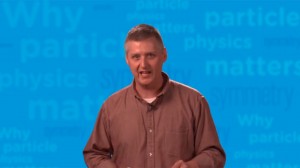
UM senior physicist Breese Quinn
OXFORD, Miss. – University of Mississippi senior physicist Breese Quinn continues to garner international attention for his research in the field of particle physics.
Quinn recently joined 700 other particle physicists at a conference to plan the next 20 years of the field. There, Symmetry magazine introduced a communication-outreach project where dozens of participants made 1-minute videos discussing why they think particle physics matters. The magazine is sponsoring a contest to determine the best video starting Aug. 20, but the number of views/likes that each YouTube video gets will factor into determining which videos are included in the contest.
“I made one of the videos, and it got a lot of good feedback at the conference,” Quinn said. “If it gets selected for the contest – not to mention if it happens to win – it could result in quite a lot of international publicity for the university.”
To view Quinn’s video, go to http://youtu.be/lb_7b0HeMNk.
Earlier this year, Quinn’s photo and brief bio on the nature of his research appeared on the “Faces and Places of Great Science and Innovation in the U.S.” poster, which was displayed at the National User Facility Organization Science Exhibition, hosted by U.S. Rep. Alan Nunnelee (R-Miss.) in his Science and National Lab Caucus in Washington, D.C.
Quinn has been involved in research at the U.S. Department of Energy’s Fermilab for more than 20 years, since he was a graduate student at the University of Chicago. Recently, his Ole Miss group was part of the analysis team that reported the first evidence for the Higgs particle.
Quinn, who is on sabbatical from Ole Miss this semester, is helping design a new Fermilab experiment that will help elucidate the matter-antimatter asymmetry in the universe.
Fermilab has awarded Quinn an Intensity Frontier Fellowship to support his new research program at the facility. The award will allow him to spend much of the next year in residence at Fermilab, focusing completely on starting new experiments to investigate the fundamental structure of the universe.
The website describing the Intensity Frontier Fellowships is http://www.fnal.gov/pub/forphysicists/fellowships/intensity_frontier/.
One of these new experiments is the Muon g-2 experiment that Quinn recently joined. The project involved moving a particle accelerator from Long Island, N.Y., to Fermilab by boat and barge, including a trip up the TennTom waterway last month.