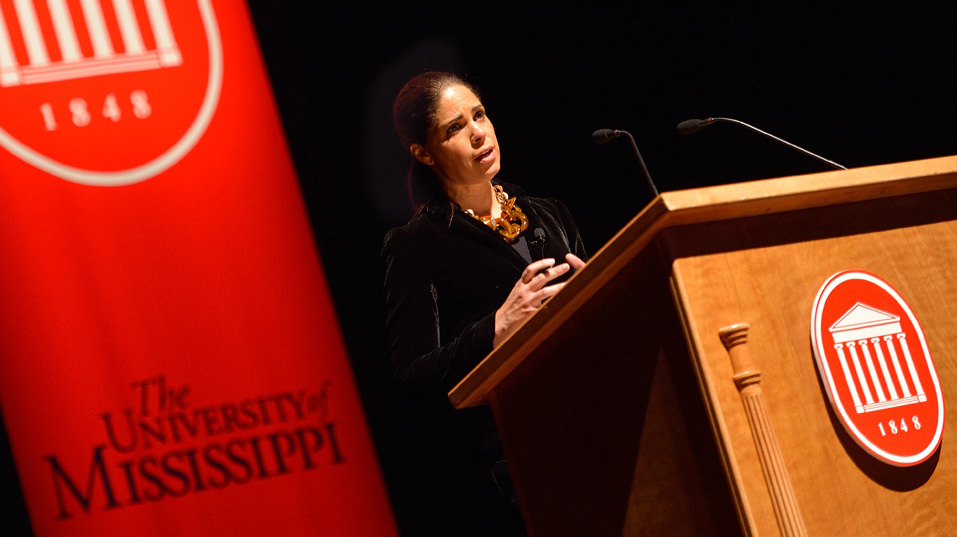
Renowned former CNN anchor Soledad O’Brien is a featured speaker as the University of Mississippi observes Black History Month in February.
OXFORD, Miss. – Delivering the closing keynote address for Black History Month observances Monday (Feb. 24) at the University of Mississippi, former NBC and CNN anchor Soledad O’Brien reflected on the national problem of racism.
Before presenting her “Black in America” tour in the Gertrude C. Ford Center for the Performing Arts, the award-winning journalist shared her perspectives with media representatives from University Communications, The Daily Mississippian and Mississippi Public Radio. Much like in her public presentation, O’Brien was insightful and reflective.
“Contrary to what many people want to believe after the election of President Barak Obama in 2008, we’re not living in a post-racial society in the United States,” O’Brien said. “What’s happening here at the University of Mississippi is a microcosm of what’s happening around the country.”
While having the nation’s attention drawn to the university following the desecration of the James Meredith statue on campus two weeks ago has created tension, O’Brien said she felt this was the best time for her to appear here.
“I began the ‘Black in America’ tour because I really wanted to bring conversations about race to schools and performing arts centers around the country,” she said. “Having visited four other cities in different regions, I’ve found there are lots of conversations about race people want to have. The history and complexity of race in this country is deeply rooted, and where we are today dates back to where we came from: the days of open discrimination in this nation.”
Besides her tour, O’Brien started Starfish Media Group, which produces documentaries for several networks.
“I really like to tell untold stories,” O’Brien said. “Those are really important. I’m giving a platform to those who otherwise might not have their voices heard in the mainstream.”
UM has a beautiful campus, but it is filled with college students who make mistakes while finding their place in the world, O’Brien said.
“Conversations about race aren’t over and they’re never quite done,” O’Brien said. “Sometimes, like now, it can be challenging and tough. Yet, people are really feeling the need to keep having dialogue that leads to understanding and acceptance of each other’s differences.”